
Human Exosome R&D Technology
Exosomes are a type of extracellular vesicle and have become a closely watched research topic in biotechnology, skin science, and cosmetic-ingredient research. Insight Genomics has long invested in genetic testing, bioinformatics, and precision health management, and continues to study the potential of exosomes in ingredient development, quality analysis, and the preparation of safety data.
Contact UsAn exosome is a tiny vesicle released by cells and is a type of extracellular vesicle. Recent research has explored the possibilities of exosomes in cell-to-cell signaling, ingredient science, skincare research, and biotechnology.
In cosmetic and skincare R&D, the focus is not only on the material itself but also on source traceability, process stability, quality testing, safety assessment, and regulatory compliance.
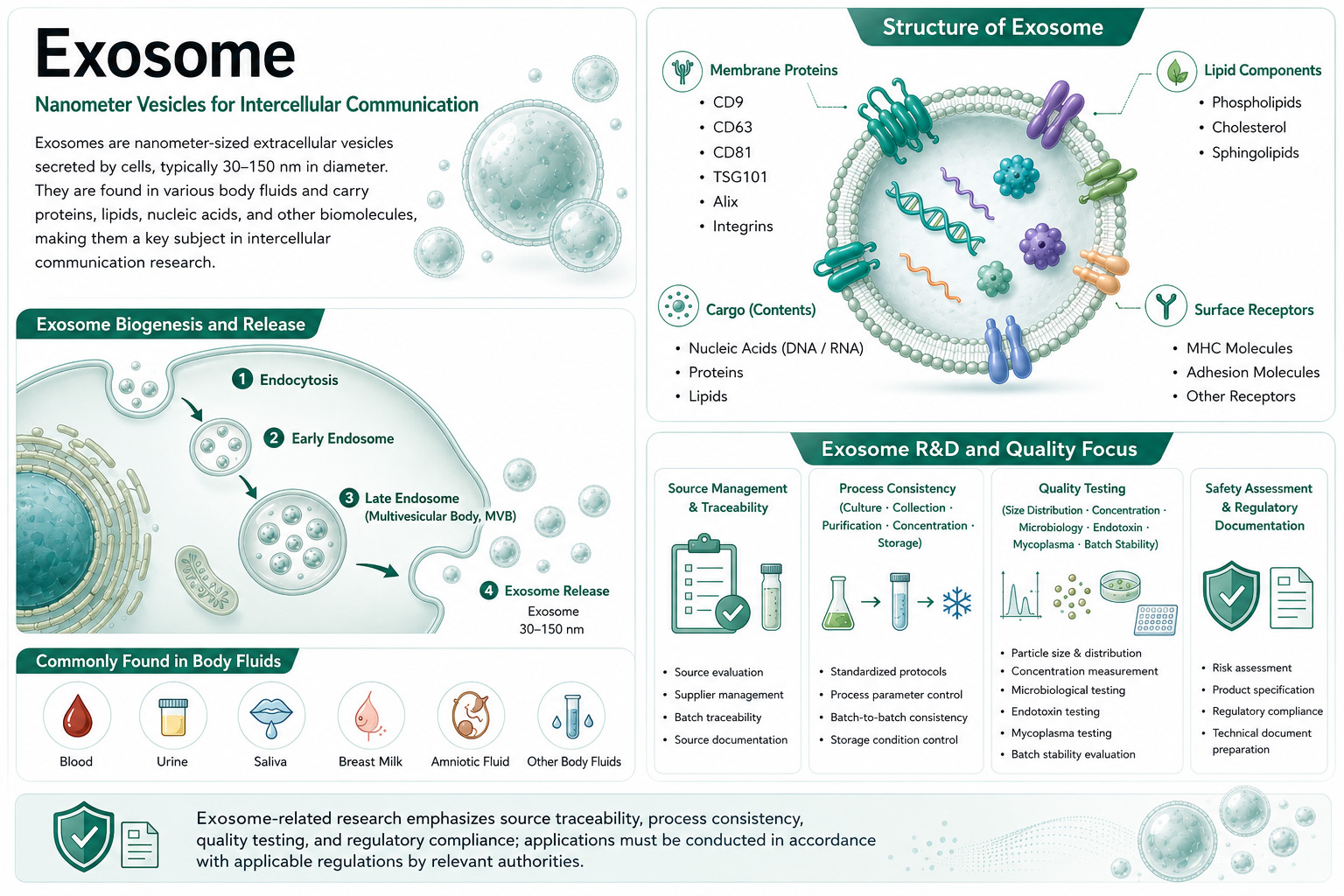
Building on our biotechnology and testing capabilities, Insight Genomics plans to establish a human exosome R&D platform focused on:
For human cell-derived exosomes, source management is a fundamental basis of R&D. We value source data, preparation records, batch management, and document retention as the basis for later quality analysis and regulatory-data preparation.
Preparing exosome materials involves cell culture, collection, purification, concentration, and storage. We continue to build standardized processes and batch records to improve the consistency and traceability of R&D data.
Exosome R&D requires multiple quality analyses, such as particle-size distribution, concentration, appearance, microbial testing, endotoxin, mycoplasma, and batch stability, which help establish material specifications and a foundation for safety documentation.
Human cell-derived exosomes intended for future cosmetic use must, under the competent authority’s regulations, have the relevant safety, quality, and process data prepared and undergo case-by-case review. We proceed on principles of compliance, safety, and traceability.
Under current Taiwan regulations, human cell-derived exosomes intended for cosmetic use must follow the case-by-case review procedure announced by the competent authority. Review materials typically cover source, preparation method, testing specifications and methods, stability, safety, and supporting data.
Therefore, R&D cannot focus on the ingredient concept alone — it must establish complete quality management, process records, test reports, and safety-assessment data as a basis for compliant downstream application.
Insight Genomics has deep experience in genetic testing and bioinformatics — specimen workflows, laboratory quality management, generation of testing data, and systematic reporting. For exosome R&D we apply the same focus on scientific data and compliance, valuing the source records, test data, and documentation completeness of every batch.
We believe that the development of exosome materials should not stop at market discussion but should return to scientific data, quality verification, and safety assessment. This is the direction guiding our exosome R&D platform.
Insight Genomics’ current human exosome work is at the R&D-technology and regulatory-data-preparation stage. This page is for R&D-technology information only and is not a guarantee of efficacy, a medical use, or a treatment claim.
Any future cosmetic or commercial application will follow Taiwan’s competent-authority regulations and be updated publicly only after the required review, product registration, product information file, and safety data are completed.
This page is an introduction to human exosome R&D technology; it is not a product sales page, nor advertising for any medical, pharmaceutical, medical-device, or therapeutic use.
Human cell-derived exosomes intended for cosmetic use must undergo the competent authority’s case-by-case review. Nothing on this page implies that any material or product has completed review or is available for commercial sale.
This page does not concern the diagnosis, treatment, prevention, or improvement of any disease and is not medical advice. Related technology and applications will be managed according to the latest regulations and the competent authority’s requirements.